
When Will Breast Implants Look Normal & 5 Tips for Recovery
April 26, 2021

One of the most common questions we get from patients is when breast implants start to look/feel normal and when the natural drop of the breasts occurs after breast implant surgery. Breast implants generally take six weeks to three months to adjust and look natural. Like many other things in life, they’re well worth the wait.
Recovery and breast implant settling time varies from patient to patient based on factors like anatomy, implant placement, and how your body heals.
Perimeter Plastic Surgery is led by Dr. Mark Deutsch, a double board certified plastic and reconstructive surgeon. During your consultation and follow-ups, our team provides a clear recovery plan and guidance so you know what changes are normal and when to reach out.
What you will learn:
- Why breast implants need time to settle
- How “drop and fluff” changes shape over time
- A post-augmentation appearance timeline
- Factors that can affect how quickly implants look natural
- Recovery tips that protect your results
The length of the adjustment period depends on a few different factors, such as your age and how much swelling you experience.
Why Do Breast Implants Need Time to Settle?
Surgically implanting anything into your body requires your body to adapt. Breast implants are foreign to your body, so your body will need some time to acclimate to your new breasts.
Displaced tissues and swelling are common in many breast augmentation surgeries. The swelling can even make your enhanced breasts appear to be unnaturally far apart for a short time post-surgery. Or, your breasts may appear tight and stiff. The swelling may also cause them to feel lumpy on top but flat on the sides.
How does the appearance of breast implants change during recovery? In the first few weeks, it is common for implants to sit high on the chest, feel firm, and look more “compressed” on top. As swelling improves and the lower breast skin relaxes, the lower pole gradually fills out and the overall shape tends to look softer and more natural.
Over time, your muscles loosen and your tissues learn to work around the implants. This is called the “drop and fluff.” When this happens, you’ll begin to see the perky, well-formed breasts you were expecting.
Understanding the ‘Drop and Fluff’ Process
The term “drop and fluff” is the process of your implants settling into a more natural position. The “drop” happens when the swelling subsides and gravity causes your breasts to drop. At first, your breasts may appear out of place, but rest assured that generally, they will drop into place within six weeks to three months. When the breasts drop, the tissues tighten around the implants, and the skin adjusts to compensate.
Timing varies. Some patients notice changes sooner, while others see gradual settling over a longer period.
“Fluff” is a strange term for your breasts as it sounds like something you would do to a pillow. While you might want to “fluff” your enhanced breasts after the surgery to make them look more natural, it won’t do any good. The “fluff” is a natural occurrence where the internal tissues accept the implants, and the breasts naturally round on the sides.
The whole process will take some time, so please be patient. Once the “drop and fluff” happens, your breasts will look and feel how you desire. Our team at Perimeter Plastic Surgery will provide you with all the aftercare and other important information you need to know about post-op recovery.
Related reading: For a more detailed recovery breakdown, see our breast augmentation recovery week-by-week timeline.
You may also like: pre and post breast augmentation care tips.
Does My Age Affect the Adjustment Period?
Yes, age can affect the adjustment period. With breast augmentation, the internal breast tissues must adjust, but the skin also has to stretch to accommodate your new implants. Each body is different, and how fast your body responds to the implants affects how long it will take them to reach your desired result.
The younger you are, the tighter your skin. Women who haven’t given birth or are breastfed also have tighter skin in the breast area. The tighter the skin, the longer it will take your body to adjust to the implants. If you are older, you can typically expect a faster adjustment period. Our skin loosens as we age, so breasts will drop more rapidly if your skin has more give in it.
Age can play a role, but timelines still vary, and your surgeon can best assess what is typical for your body and implant plan.
Also, the larger you go with your implants, the longer your healing process will take. Smaller implants require less adjustment. Likewise, textured implants take longer to drop and fluff. Because your breast tissues are smooth, a textured implant is even more foreign to them, so your body will need more time to adapt.
Implant type and placement can influence breast implant settling time, so your surgeon’s recommendations and your individual healing response are the best guide for what to expect.
Post-Augmentation Appearance Timeline (What You May Notice)
Below is a general timeline. Your experience may differ, and your surgeon’s instructions should always be your guide.
- Week 1: Swelling and tightness are usually most noticeable. Implants can appear high, and the upper breast may look full.
- Weeks 2-4: Swelling begins to improve. The chest starts to feel less tight, and shape changes may happen gradually.
- Weeks 6-12: Many patients notice a more natural “settled” look as the implant pocket softens and the “drop and fluff” progresses.
- Months 3-6: Subtle changes can continue as residual swelling resolves and tissues relax further.
If a breast implant feels weird when I bend over, it can be unsettling, especially early on. Some patients notice mild tightness or shifting sensations while tissues are still healing and the implant pocket is adjusting. If the feeling is sharp, painful, sudden, or comes with visible asymmetry, contact your surgeon for personalized guidance.
5 Tips for Ensuring Optimal Breast Augmentation Results
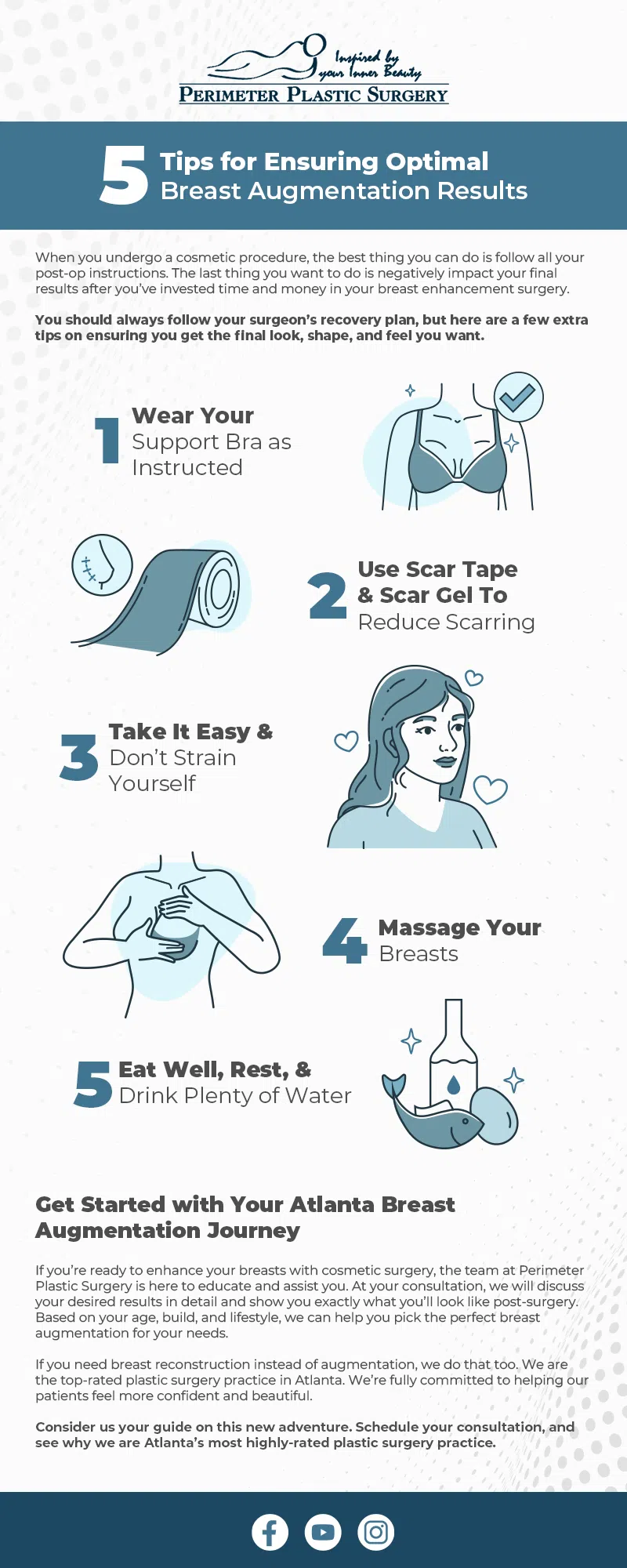
Infographic ‘5 Tips for Optimal Breast Augmentation Results’ by Perimeter Plastic Surgery
When you undergo a cosmetic procedure, the best thing you can do is follow all your post-op instructions. The last thing you want to do is negatively impact your final results after you’ve invested time and money in your breast enhancement surgery. You should always follow your surgeon’s recovery plan, but here are a few extra tips on ensuring you get the final look, shape, and feel you want.
1. Wear Your Support Bra as Instructed
Your surgeon should provide you with a special post-surgery bra that will support your breasts as they heal. Don’t skip out on wearing it. Many patients fear it will be uncomfortable, but these bras were designed for comfort and to aid the recovery process. Your specialized bra will minimize discomfort and protect you as your body heals and adapts to the new breast implants. Wearing the bra is also vital to proper alignment. A supportive surgical bra puts your breasts in the right position for the drop and fluff.
Surgical bras are designed with a front opening, so they won’t pull on your breasts when you move. You should wear your bra day and night for at least two weeks. Your surgeon will let you know when you can switch to daytime-only wear.
Once you get the all-clear to ditch your support bra, you should continue to wear a bra. When you exercise, wear a sports bra and then a regular bra any other time you are awake. If you don’t wear a bra, your breast implants can start to droop. Many people mistakenly assume that breast implants can’t sag, but that’s not the case.
2. Use Scar Tape & Scar Gel to Reduce Scarring
You’ll be sent home with silicone sheets over your incision sites post-surgery. These silicone sheets reduce your chance of developing keloid scarring and keep bacteria from entering the incisions. To minimize any scarring, use medical-grade scar gel for a minimum of two to three months post-surgery. Scar gel will soften and diminish your scars.
3. Take It Easy & Don’t Strain Yourself
Avoid lifting heavy objects or strenuous activities for three to four weeks after breast augmentation surgery. Arrange to have help so that you can reduce your movement. Don’t bend, stretch, or lift anything, even moderately heavy, if you can help it. As a rule of thumb, don’t pick up anything heavier than a gallon jug of milk. Moving too much or picking up something too hefty increases your risk of capsular contracture.
Breast implants require patience and commitment, and the recovery process will affect your typical daily life. But with time, you’ll be able to do all the exercises and things you did before surgery.
Even if your swelling quickly subsides and you feel great, that first month post-surgery is not the time for major projects. Plan to have help around the house or with small children so you don’t have to risk your results. In the scheme of things, a month of restricted activity is nothing to achieve the breasts you’ve imagined.
Also, avoid any special occasions where formal, tight-fitting clothing is required. Wear loose-fitting tops that button in front. Front buttons let you put on your shirt without lifting your arms above your head. Clothing that’s too tight puts added stress on your breast implants and the healing tissues.
4. Massage Your Breasts
If your surgeon recommends them, give yourself gentle breast massages. A massage boosts circulation and helps your breast implants settle into a natural position. Your medical team will give you instructions on how to massage your breasts. Stick to these instructions, as a heavy massage can impede your healing process. However, remember that you shouldn’t massage your breasts if you’ve had a breast lift plus augmentation.
5. Eat Well, Rest, & Drink Plenty of Water
How you treat your body post-surgery will affect how well it heals and how fast. Stay away from junk food and alcohol while you recuperate, and abstain from smoking. Leading up to surgery, eat plenty of healthy food like fruits and vegetables. Post-surgery, continue to eat well. Have your post-surgery food stocked in your fridge and pantry, plus easy, quick meals planned.
No one likes to wait, but breast implants don’t give you the look you want overnight. Your body has to heal and adjust. All good things take time, so remember to follow all of your instructions and take care of yourself. If you eat well, avoid anything strenuous, and wear your supportive surgical bra, you can expect amazing results from your breast implantation surgery.
Get Started with Your Atlanta Breast Augmentation Journey
If you’re ready to enhance your breasts with cosmetic surgery, the team at Perimeter Plastic Surgery is here to educate and assist you. At your consultation, we will discuss your desired results in detail and show you exactly what you’ll look like post-surgery. Based on your age, build, and lifestyle, we can help you pick the perfect breast augmentation for your needs.
If you need breast reconstruction instead of augmentation, we do that, too. We are the top-rated Atlanta plastic surgery. We’re fully committed to helping our patients feel more confident and beautiful.
Consider us your guide on this new adventure. Schedule your consultation, and see why we are Atlanta’s most highly-rated plastic surgery practice.
Frequently Asked Questions
When Do Breast Implants Start Looking More Natural After Surgery?
Many patients see the biggest visual changes in the first 6 to 12 weeks as swelling improves and implants begin to settle. Subtle settling can continue for several months as tissues soften and the “drop and fluff” completes.
What Can I Do If My Implants Still Look High Or Feel Tight?
A high, tight look is common early on and often improves as swelling decreases and tissues relax. Follow your post-op plan and support-garment instructions. If tightness is worsening, painful, or paired with new asymmetry, contact your surgeon promptly.